- Apocephalus
- Melaloncha
- Dohrniphora
- Fossil Phorids in Amber
- Backyard Biodiversity
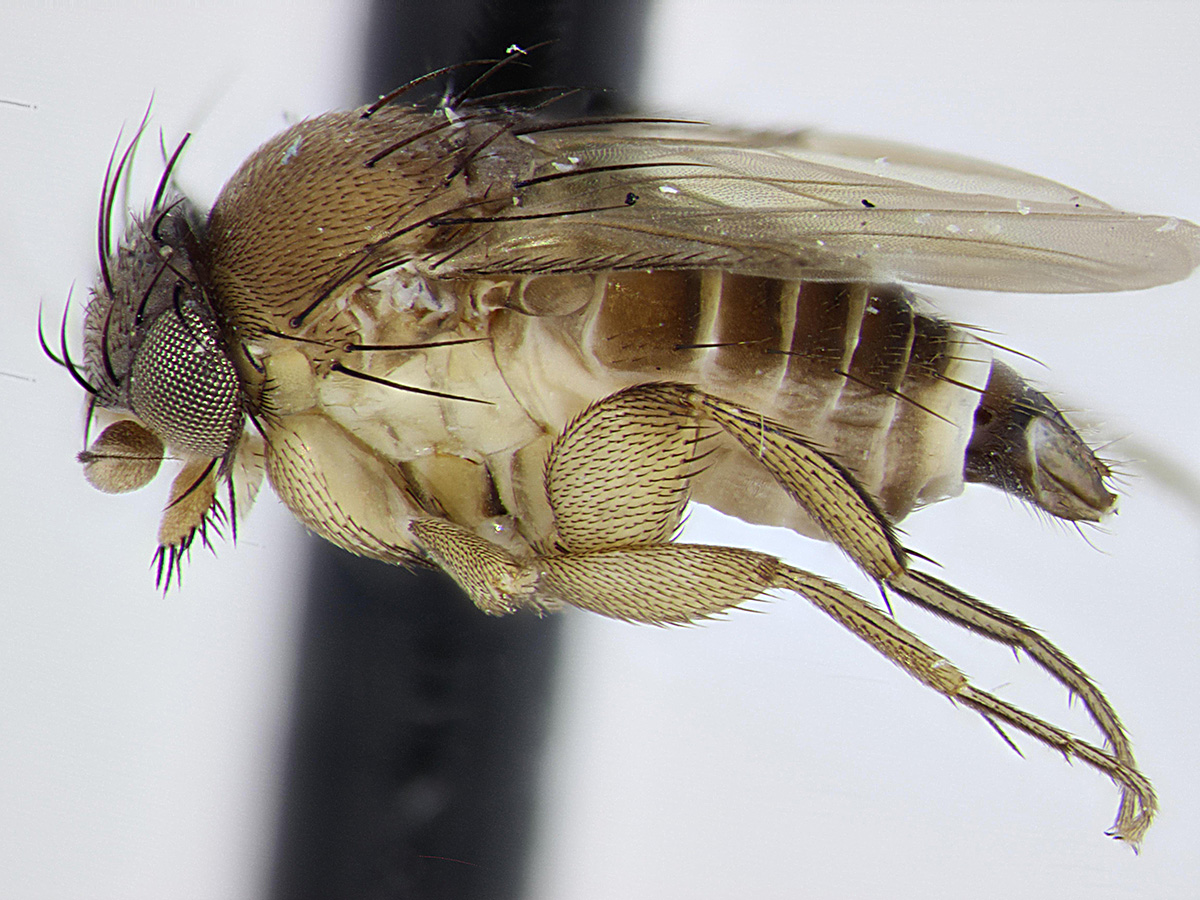
Apocephalus meekerjensenaeSystematics of ant-decapitating flies, genus Apocephalus; funded by National Science Foundation
grant DEB-9407190 to Brian Brown &
grant DEB-1025922 to Brian Brown and Paul Smith.
The genus Apocephalus Coquillett is a huge, poorly-known group of New World flies that parasitize a range of hosts. Found from rain forests near the equator to tree line in northern North America and southern Argentina (but absent from Chile), these small, 1-3 mm long flies belong to one of the largest genera of the family Phoridae. Before our work, there were 87 described species; the number is now 277 species and still climbing, with entire large groups and over 100 species still not revised.
Apocephalus is currently organized into two subgenera: Apocephalus sensu stricto and Mesophora Borgmeier. The species of Apocephalus s. s. are the true "ant-decapitating flies" that Brown (1997a) organized into 5 groups: the A. attophilus group (mostly parasitoids of attine leaf-cutting ants), A. miricauda group (mostly parasitoids of ponerine ants), A. pergandei group (mostly parasitoids of Camponotus carpenter ants), A. feeneri group, and A. grandipalpus group. Of these, Brown (1997a, 2000, 2002) revised the first three, leaving two large groups, the A. feeneri and A. grandipalpus groups, both mostly parasitoids of Pheidole ants, still awaiting treatment. There are a few species of Apocephalus that do not fall into any of these informal groups.
Melaloncha about to attack a beeSystematics of bee-killing flies,
genus Melaloncha; funded by National Science Foundation
grant DEB-0090031 to Brian Brown & grant DEB-0315271 to Brian Brown and Paul Smith
Species of the genus Melaloncha are among the most interesting of all phorid flies. Found almost exclusively in the Neotropical Region, they are internal parasitoids of a number of species of bees, especially stingless bees. The flies are among the most brightly colored and attractive phorids, with various species having contrasting dark and yellow to orange patches, metallic, greenish-blue eyes and abdominal patches of reflective, silvery pollinosity. They are of relatively large size, in the 3-6mm range, which, combined with their bright colors, allows them to claim the title of being the "butterflies of the phorid family."
The way of life of most species is unknown, but all are believed to be parasitoids of bees, with the known hosts being stingless bees, bumble bees and the introduced honey bee, Apis mellifera. Female flies attack the bees either while they are foraging on flowers, or near their nests. We have recently discovered that the flies use a variety of methods to attack their hosts, but many of them curl their ovipositors under the abdomen, up between the legs so that the point of the stylet is extending beneath the head. The fly then rushes forward towards a bee and jabs her ovipositor into the bee's body, injecting a single egg. This happens extremely quickly and is difficult to observe, but it appears that the eggs are laid in the head or the thorax. Some species attack the bees while they (the flies) are flying- these species usually lay eggs in the host abdomen. In either case, the fly larva hatches from the egg and consumes the internal contents of the bee, eventually killing it.
Dohrniphora cornuta - photo by S.A. Marshall Basal lineages of the Phoridae,
and
systematics of the genus Dohrniphora; funded by National Science Foundation
grant
DEB-0516420 to Brian Brown
and Paul Smith
Most species of Phoridae are undescribed. The current total of 3,700 species is a small fraction of the 20-50,000 species estimated to be in existence. Without names, or the ability to identify species, we will never learn about the diverse lifestyles and ecological roles of these ever-present flies.
To try to remedy this situation, we are working to revise some of the largest genera of phorid flies. In particular, we are revising the New World species (most of which are Neotropical) of the largest genus of primitive phorids, Dohrniphora Dahl. This genus is found worldwide, but is by far most diverse in the New World tropics, where 85 of the 152 known species occur. The few species of Dohrniphora with described life histories are scavengers, predators, and parasitoids, but some might be specialized within specific habitats (e.g. army ant colonies, termite nests). One species, D. cornuta (Loew), is found in most warm parts of the world as a scavenger that probably has been distributed by human activity.
fossil phorid in Baltic amber
Besides studying recent phorid flies, we also do research on phorid fossils, especially those trapped and preserved in amber. Integrated with information from our Basal Lineages molecular phylogeny project, fossils can provide important clues about the evolution and biogeography of the family Phoridae.
Phorid fossils were reviewed by Brown (1999). The earliest evolutionary history of the Phoridae is in general poorly known, with the first recognizable phorid fossils we have seen being from the Cretaceous of Burma, although early fossils are said also to be present in Lebanese amber. During the Burmese amber period, the two main lineages of phorids were already present: the Sciadocerinae (formerly considered a separate family) and the Phoridae s.s. There are a modest number of fossils of each of these groups from other Cretaceous ambers as well (Arillo & Mostovski 1999; Brown & Pike 1990; Grimaldi & Cumming 1999; McAlpine & Martin 1966), including some intriguing stem-group Phoridae, classified in a subfamily Prioriphorinae by Mostovski (1999), that fall outside the crown-group Euphorida characterized by Brown (2007).
New species of robber fly collected in Dr. Brian Brown'sMonrovia, CA backyard.
The “nature” that most people in the Los Angeles basin experience is the assemblage of plants and animals in urban parks and suburban backyards. Birds and mammals are well known, with urban coyotes and feral parrots being part of L.A.’s distinctive culture, but less understood is the fauna of insects and other small creatures. Composed of native species that can survive (or thrive) in these new conditions, along with foreign introductions and invaders, this “altered nature” of homes and gardens is surprisingly diverse and poorly known. It is also constantly changing, with a rain of new introductions, due to human commerce, frequently providing new species for our area.
This project is still in its earliest stages. Please check back later to see where this exciting exploration leads us…